
1. What is Fire Resistant / Fire Rated Ventilation Duct?
Duct used for the distribution or extraction of air and designed to provide a degree of fire resistance
2. What is Smoke Extraction duct?
Duct used for the extraction of smoke in case of fire and designed to provide a degree of fire resistance
3. What is the difference between Normal ducts and Fire rated ducts?
- Normal Ducts:
No protection against fire and doesn’t prevent fire spread.
Lighter construction, not fit for fire resistant application.
Tested for air leakage only (if deemed necessary) - Fire Rated Ducts :
Restricts fire spread from Outside and Inside duct up to certain time.
Stronger and more rigid than normal ductwork.
Tested for different international standards for fire resistance (BS, EN, ASTM, UL etc)
4. What are the criteria considered for fire resistance ratings?
- Stability: Ducts and supports are intact
- Integrity: Ducts are free of cracks and holes
- Insulation: Limit temperature on Insulation surface
- Kitchen Extraction: Limit the fire inside the duct
- Smoke Extract: Limit the reduction in cross section
5. What are the main compliance standards for smoke & ventilation ducts?
- BS 476-24
- EN 1366-1,-8,-9
- EN 13501-4
- ISO 6944
- ASTM E2816-12
6. What is Standard Time-Temperature Curve
Standard fire tests to which specimens of constructions are subject to, are based on the Cellulosic time/temperature curve, as defined in various national standards, e.g. ISO 834, BS 476: part 20, DIN 4102, AS 1530, etc.
This curve is based on the burning rate of the materials found in general building materials and contents.

7. What is the maximum temperature when tested with full time/temperature curve up to 120 min./ 2 hours?
1049 º C
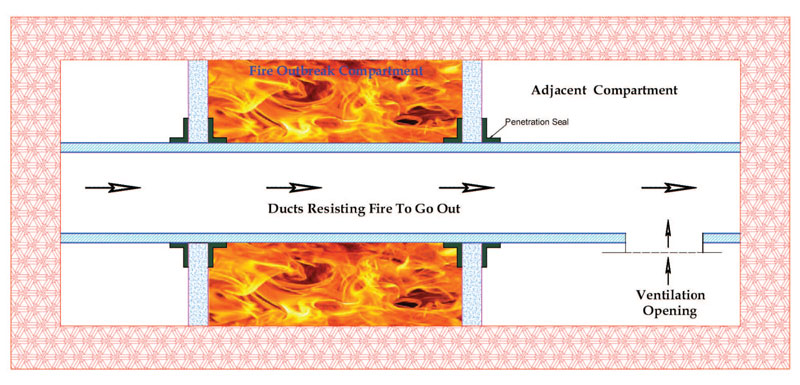
8. What are the two fire conditions?
Type A: Fire Outside (generally for applies ventilation ducts)
Type B: Fire Inside (extraction ducts)
In any building/premises both these conditions are possible in the event of fire
9. If I use just Rockwool (or any non-combustible) Insulation over the normal ducts, will that be okay to be considered as fire protection?
NO.
Sometimes contractors wrap normal ventilation ducts with Rockwool or non-combustible insulation of any thickness/density. This is absolutely wrong and is considered detrimental to building safety. If the ductwork loses stability / integrity, Insulation will fail as it will move with the collapse of ducts.
It is very important to understand that ‘We can have an Integrity-Stability rating without Insulation rating, but NOT an Insulation rating without Integrity-Stability’.
Insulation is totally dependent upon the ductwork maintaining its integrity and stability.
Overall, it’s the system (DUCT + INSUALTION) that works. It delivers the highest possible protection against fire. Therefore, it is important for an Insulated Fire rated duct to be tested and certified as a single system.
10. Is it advisable to support other services using fire rated ductwork supports?
NO
Any additional services connected to fire ductwork supports may add unknown load bearing factors, which in case of fire may impact the stability of the ductwork just when it is needed most. Ductwork Installations have to be strictly in compliant with manufacturers certified performance specifications.
11. What is difference between coated and non-coated fire rated ducts?
Coated Ducts :
- Special paint/coating applied on to the steel ducts
- Lighter in construction
- Limited temperature exposure 400oC Max (for Insulated)
- For Stability & Integrity full std. TT curve exposure
Non-coated Ducts :
- Bare steel ducts with relatively heavier construction (GI/MS/SS finish)
- Exposed to full Standard time-temperature curve (for both Insulated and Uninsulated)
12. Is the Ducts coated with Fire Resistant paint qualify as Fire Rated Duct?
Ducts coated with Fire Resistant paint may not completely qualify as Fire Rated Duct.
Coated ducts can qualify for Stability & Integrity criteria when exposed to full time-temperature curve however it does not qualify for insulation criteria.
Insulation criteria for coated ducts is limited to maximum 400º C temperature only.
13. Can I use any insulation materials to wrap fire rated ducts?
No.
It has to be as tested and certified as a single system. Insulation and installation method will be recommended by certified manufacturers based on the assessment approvals from testing and certification body.
14. What about ducts supports systems and wall penetration ducts?
Ducts have to be supported strictly as per manufacturers specifications and installation guidelines. Support system assessment must be based on test performance.
Wall penetration design is exactly as per test conditions. Manufacturers’ will provide necessary training and guidelines to install it.
15. Why are smoke extraction ducts in buildings insulated?
During the event of fire, smoke removal process results in potential risk of flashover or thermal radiation feedback. This will ignite nearby combustible materials or gases in adjacent transporting areas spontaneously due to higher temperatures.
By insulating smoke extraction ducts, we are limiting the risk by preventing flashovers which may be caused while transporting hot gases from the place of fire to the atmosphere. Any kind of secondary fire can be encountered by firefighters easily due to removal of hot gases from the place of fire.
16. Is the Smoke Extraction Duct always insulated?
No.
Not if it passes through dedicated shafts which are fire rated with insulation.
Otherwise, it is highly recommended to be insulated.
17. Does the insulation need to be tested along with the ductwork?
Yes, it has to be.
It is the system that has to work. Stability, Integrity and Insulation have to be tested together as a system.
Smoke extract ductwork is an emergency system and insulation will be able to control the exhaust temperatures. However this had to be proven in a fire test.
18. Does smoke extract ductwork need to be insulated on the roof?
Not necessary.
On the roof, the smoke extract ductwork terminates to the atmosphere, and the flashover risk no longer exists generally.
However, if there is a proximity of certain services and equipment mounted on the roof, then it is recommended.
19. Should fire dampers be included in a smoke extract ducts?
No.
The primary function of smoke duct is to carry hot gases from the place of fire out in to the atmosphere. A fire damper will close and prevent smoke extraction functions.
20. Why Kitchen Extraction duct has to be insulated?
Kitchen extract ductwork poses a specific risk due to the presence of combustible grease lining (cooking oil fumes become grease) inside the ductwork. When ductwork passes through multiple compartments, there is a risk from a fire in a compartment outside the kitchen. This can cause the grease inside the duct to ignite and spread fire inside the ducts throughout the building.
21. Do I need to insulate ducts inside the kitchen?
No.
Insulation on the ducts in the kitchen provide no protection. A fire in a commercial kitchen will be subject to the kitchen suppression systems and compartmentation structure.
22. Can fire damper be installed in kitchen extract ducts?
No
Fire dampers are used to maintain compartmentation in the event of fire, to restrict spread of fire from one location to another to prevent migration of fire through the building.
Due to the presence of grease inside the ducts, fire dampers become inoperable. Hence, they offer no protection against fire and damage.